Greek Salad (Horiatiki)
By Middagsarkivet
- Easy
- 4 servings
In Greece this is horiatiki, village salad, and it contains no lettuce at all. In Nordic kitchens it has become the default summer salad, the thing that appears on the table from late June through August alongside whatever is on the grill. The reason is simple: it depends entirely on ripe tomatoes, and the Nordic tomato season is short enough that people cook around it while it lasts.
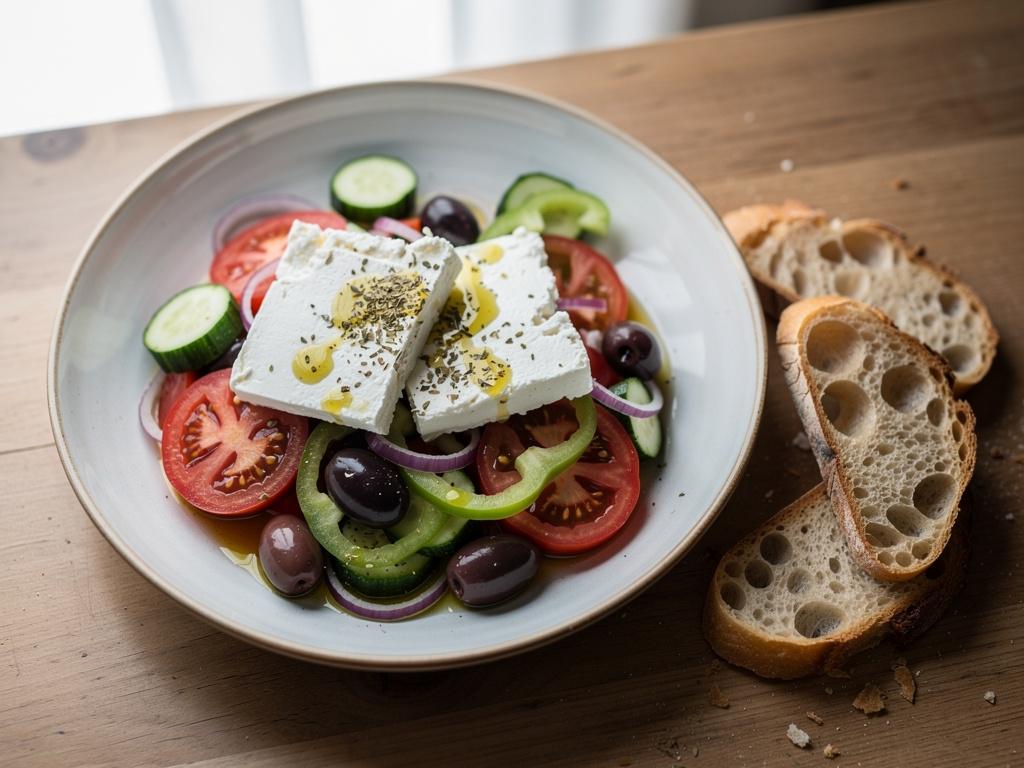
Feta in an American supermarket is usually sold crumbled in a tub, which is fine but not ideal here. Buy the block packed in brine if you can find it, cut a thick slab, and set it on top of the salad rather than mixing it in. That is how it is served in Greece, and it keeps the cheese from dissolving into the juices at the bottom of the bowl.
The dressing is not really a dressing. Good olive oil, a splash of red wine vinegar, dried oregano crushed between your fingers, salt. Everything else is the vegetables doing the work, which means there is nowhere to hide a pale winter tomato.
How to make it
- 1
Salt the tomatoes
Cut the tomatoes into thick wedges, put them in a wide serving bowl and sprinkle with salt. Let them sit while you prepare everything else so the juices start to run.
- 2
Soak the onion
Slice the red onion as thinly as you can and put it in a small bowl of cold water. This takes the raw edge off. Drain well before using.
- 3
Cut the vegetables
Halve the cucumber lengthwise and cut it into thick half moons. Seed the bell pepper and slice it into rings. Add both to the tomatoes along with the olives and the capers, if using.
- 4
Dress it
Add the drained onion. Pour over the olive oil and the red wine vinegar, crush the dried oregano between your fingers over the top, and grind on black pepper. Turn everything gently with your hands or two spoons.
- 5
Add the feta
Lay the slabs of feta on top of the salad, drizzle them with a little more olive oil and dust with the last of the oregano. Do not stir it in.
- 6
Rest before serving
Let the salad stand at room temperature for 10 minutes so the tomato juice, oil and vinegar pool together at the bottom. That liquid is the point, so serve it with bread.
A couple of tips
Salt the tomatoes first and separately. It draws out juice that becomes half the dressing, and it seasons the fruit rather than just the surface.
Never refrigerate the tomatoes before making this. Cold kills tomato flavor and the texture goes mealy. Room temperature throughout.
If you can only find crumbled feta, rinse it briefly and drain it well, then scatter it over the top at the last moment instead of tossing it through.
Serving
Serve with crusty bread or warm pita to mop the bowl, as a side to grilled lamb, chicken or fish. In summer it works as a light lunch on its own with an extra slab of feta.
Storing it
Best eaten within an hour of assembling. Leftovers keep covered in the refrigerator for up to 2 days, but the cucumber softens and the feta absorbs the dressing. Let it come back to room temperature before eating and drain off some of the liquid.
Nutrition per serving
| Calories | 370 kcal |
|---|---|
| Fat | 32 g |
| of which saturated | 10 g |
| Carbohydrates | 17 g |
| of which sugars | 9 g |
| Fiber | 4 g |
| Protein | 10 g |
| Salt | 3 g |
Questions and answers
- Can you make Greek salad ahead of time?
- You can cut the peppers, onion and olives a few hours ahead and keep them covered, but cut the tomatoes and dress the salad no more than 30 minutes before serving.
- Why is there no lettuce in Greek salad?
- Traditional horiatiki is built on tomato and cucumber, and lettuce would just wilt into the dressing. Adding it makes a different salad, not a better one.
- What can I use instead of feta?
- A firm, salty sheep's milk cheese works, and Bulgarian or French feta are both fine. Avoid soft fresh cheeses like mozzarella, which lack the salt the salad needs.
- Can you freeze Greek salad?
- No. Everything in it is raw and high in water, and it turns to mush when thawed.
- What tomatoes should I buy?
- Whatever is ripe and in season, ideally from a farm stand in July or August. Vine, beefsteak and large heirlooms all work; out of season, cherry tomatoes are the safer bet.
This dish belongs to
Collections
Similar recipes

How it was made
This recipe was written by a language model. Below is what it cost, how long it took and when each step ran, so you can see how the archive comes about.
- $0.230
- 1 min 34 sec
- 5
- Passed
| Date | Step | Model | Usage | Time | Cost |
|---|---|---|---|---|---|
| Sep 23, 2026 | Wrote the recipe | anthropic/claude-opus-5 | 6,863 in · 2,982 out tokens | 37.8 sec | $0.109 |
| Sep 23, 2026 | Checked food safety | anthropic/claude-sonnet-5 | 2,247 in · 19 out tokens | 2.1 sec | $0.005 |
| Sep 23, 2026 | Made the picture | bfl/flux-2-max | 1 image | 25.5 sec | $0.070 |
| Sep 23, 2026 | Worked out the nutrition | anthropic/claude-opus-5 | 1,575 in · 1,396 out tokens | 17.8 sec | $0.043 |
| Sep 23, 2026 | Set the collections | anthropic/claude-sonnet-5 | 1,508 in · 35 out tokens | 6.9 sec | $0.003 |