Danish Pastry (Wienerbrød)
By Middagsarkivet
- Hard
- 12 servings
In Denmark, wienerbrød means Viennese bread, because the technique arrived with Austrian bakers hired during a Copenhagen bakery strike in the 1850s. The Danes kept the lamination, added more butter, and started filling the pastries with remonce, a paste of butter, sugar and almond paste that has no real equivalent in an American bakery case.
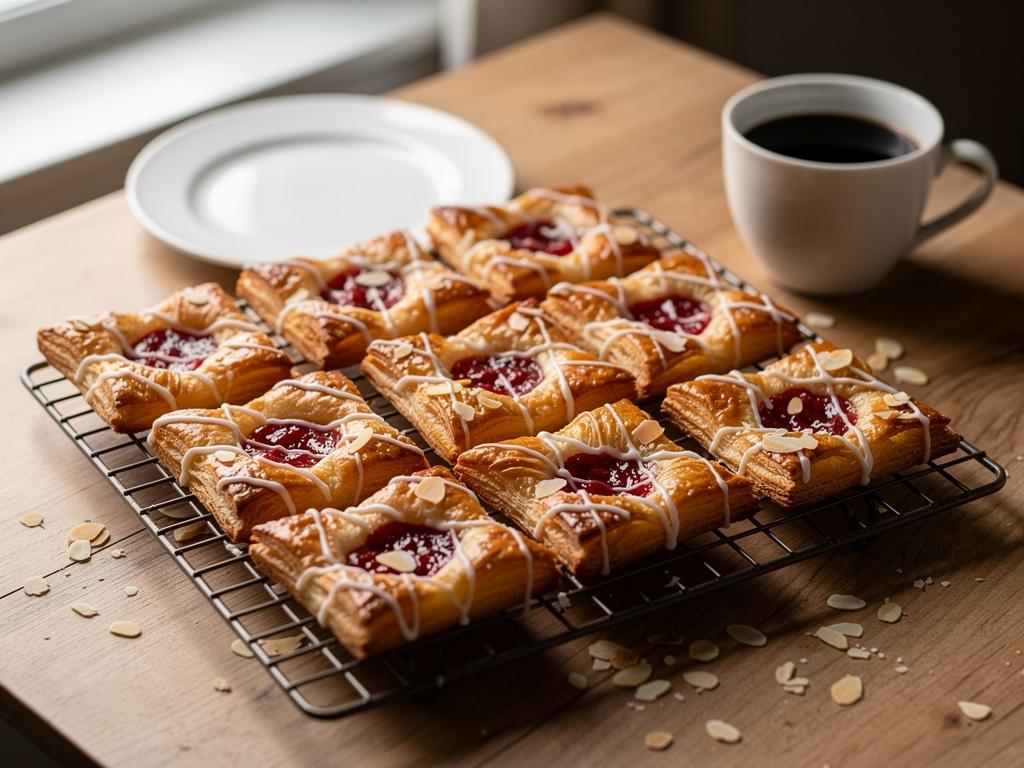
Most Danes buy their wienerbrød on a Saturday morning from the bakery down the street. Making it at home is a weekend project: the dough rests overnight in the refrigerator, and the folding happens in short bursts with half an hour of chilling in between. The shape here is the spandauer, a square with the corners folded toward the center and a spoonful of jam in the middle. Danish bakeries also use raspberry or apricot; use what you like.
Two rules decide whether this works. The butter and the dough must be the same firmness when you roll them, and the pastries must go into a fully heated oven. Warm butter melts into the dough instead of staying in layers, and a lukewarm oven lets the butter run out onto the pan before the steam can lift the dough.
How to make it
- 1
Mix the dough
Whisk the lukewarm milk and yeast together in a large bowl and let stand 5 minutes. Add the egg, sugar, salt, cardamom, softened butter and the flour, and stir to a shaggy dough. Knead briefly, about 2 minutes, just until smooth. Do not develop it further and do not taste the raw dough.
- 2
Chill the dough
Pat the dough into a rough square, wrap it, and refrigerate at least 1 hour or overnight.
- 3
Make the butter block
Put the cold butter and 2 tablespoons flour between two sheets of parchment and beat and roll it into a 6 by 6 inch (15 by 15 cm) square. It should be pliable but still cold. Refrigerate until the dough is ready.
- 4
Lock in the butter
On a floured counter, roll the dough into a 12 by 12 inch (30 by 30 cm) square. Set the butter block in the center at a 45 degree angle, like a diamond, and fold the four corners of the dough over it so they meet in the middle. Pinch the seams closed.
- 5
First fold
Roll the packet out to a rectangle roughly 8 by 20 inches (20 by 50 cm), keeping the edges straight. Fold it in thirds like a letter. Wrap and refrigerate 30 minutes.
- 6
Second and third folds
Repeat the rolling and letter fold twice more, with 30 minutes in the refrigerator after each. If butter starts to break through the surface, dust with flour and chill longer before continuing.
- 7
Make the remonce
Beat the grated almond paste, softened butter and sugar together to a smooth, spreadable paste.
- 8
Cut and fill
Roll the chilled dough to a 12 by 16 inch (30 by 40 cm) rectangle and cut it into twelve 4 inch (10 cm) squares. Put a heaping teaspoon of remonce in the center of each, fold the four corners in to meet over the filling, and press down firmly in the middle.
- 9
Proof
Set the pastries on two parchment lined sheet pans, cover loosely, and let rise at room temperature until visibly puffy and slightly jiggly, 45 to 60 minutes. Meanwhile heat the oven to 400°F (200°C).
- 10
Bake
Brush the pastries with beaten egg, press a small spoonful of raspberry preserves into the center of each, and scatter sliced almonds over the edges. Bake one sheet at a time for 16 to 18 minutes, until deep golden brown and dry in the folds.
- 11
Glaze
Cool on a rack for 10 minutes. Stir the confectioners' sugar with the water and vanilla extract to a thick but pourable icing, adding drops of water as needed, and drizzle it over the warm pastries.
A couple of tips
Everything hinges on temperature. If the kitchen is warm and the dough starts to feel soft or sticky at any point, stop and put it back in the refrigerator for 20 minutes.
Press the folded corners down hard into the center before proofing, or they spring open in the oven and the filling escapes.
Almond paste and marzipan are not the same thing. Almond paste is less sweet and coarser, which is what remonce needs; if you only have marzipan, cut the sugar in the filling in half.
What you need
- rolling pin
- bench scraper
- parchment paper
- two sheet pans
Serving
Serve warm with coffee for a weekend breakfast, or as the centerpiece of an afternoon fika with strong black coffee and nothing else on the table.
Storing it
Best the day they are baked. Keep leftovers in a paper bag or loosely covered at room temperature for up to 2 days, and crisp them for 5 minutes in a 350°F (175°C) oven before serving. Do not refrigerate, it makes the layers tough.
Nutrition per serving
| Calories | 550 kcal |
|---|---|
| Fat | 30 g |
| of which saturated | 15 g |
| Carbohydrates | 64 g |
| of which sugars | 32 g |
| Fiber | 2 g |
| Protein | 8 g |
| Salt | 1 g |
Questions and answers
- Can you freeze Danish pastries?
- Yes. Freeze them baked but unglazed for up to 2 months, then reheat from frozen at 350°F (175°C) for 10 minutes and ice them after. Shaped, unbaked pastries also freeze well: thaw and proof them on the pan for about 2 hours before baking.
- Can the dough be made the day before?
- That is how it is usually done. Complete all three folds, wrap the dough, and refrigerate it overnight, then roll, fill and bake in the morning.
- What can I use instead of almond paste?
- A filling of 4 tablespoons softened butter, 1/3 cup sugar and 1 teaspoon cinnamon works as a plain remonce, which is what Danish bakeries use for the cinnamon snail version.
- Why did butter leak out during baking?
- Either the dough was too warm when it was rolled, so the butter blended into the layers, or the oven was not fully heated. Preheat for a full 20 minutes and chill the shaped pastries for 15 minutes if the kitchen is hot.
- Can I use store-bought puff pastry?
- You can, but it is not wienerbrød. Puff pastry has no yeast, so it bakes up flaky and flat rather than soft and bready in the center.
This dish belongs to
Collections
Similar recipes
How it was made
This recipe was written by a language model. Below is what it cost, how long it took and when each step ran, so you can see how the archive comes about.
- $0.284
- 1 min 52 sec
- 5
- Passed
| Date | Step | Model | Usage | Time | Cost |
|---|---|---|---|---|---|
| Oct 15, 2026 | Wrote the recipe | anthropic/claude-opus-5 | 7,936 in · 4,789 out tokens | 1 min 1 sec | $0.159 |
| Oct 15, 2026 | Checked food safety | anthropic/claude-sonnet-5 | 2,955 in · 215 out tokens | 3.2 sec | $0.008 |
| Oct 15, 2026 | Made the picture | bfl/flux-2-max | 1 image | 24.5 sec | $0.070 |
| Oct 15, 2026 | Worked out the nutrition | anthropic/claude-opus-5 | 1,710 in · 1,405 out tokens | 17.2 sec | $0.044 |
| Oct 15, 2026 | Set the collections | anthropic/claude-sonnet-5 | 1,504 in · 23 out tokens | 1.7 sec | $0.003 |