Æbleskiver (Danish Pancake Balls)
By Middagsarkivet
- Medium
- 4 servings
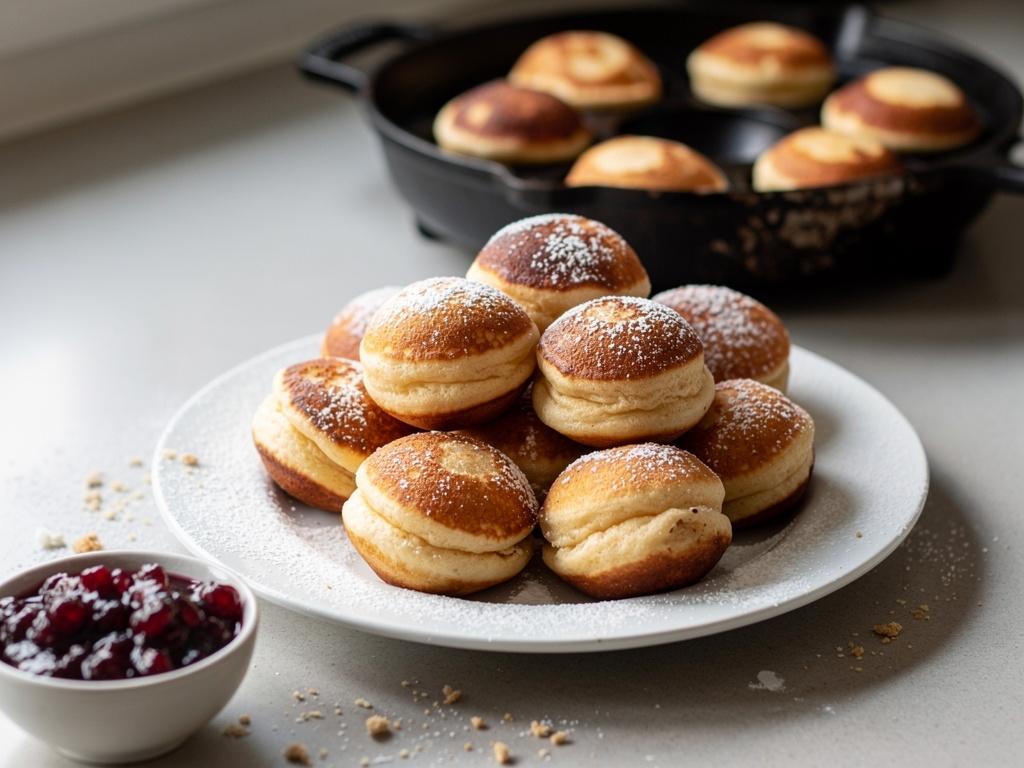
Æbleskiver belong to December in Denmark. They show up at Christmas markets, at the office julefrokost, at the kind of Sunday afternoon where the gløgg is already warm, and they are almost always served in threes with a heap of confectioners' sugar and a small bowl of jam. Frozen bags of them sit in every Danish supermarket freezer from November on, which tells you something about how many get eaten and how few people make them from scratch.
The name means apple slices, and the oldest versions did hold a piece of apple. Somewhere along the way the apple dropped out and the batter stayed. What makes them work is the pan: a heavy cast iron plate with seven round wells, turned with a skewer so the batter folds around itself into a sphere. The turning looks like a trick and is mostly nerve. Your first two will be lopsided.
Lingonberry preserves are the standard Nordic dip and are sold at IKEA and in many supermarkets; raspberry jam is the usual stand-in and no Dane will object.
How to make it
- 1
Mix the dry ingredients
Whisk the all-purpose flour, sugar, baking powder, cardamom and salt together in a large bowl.
- 2
Make the batter
Whisk the egg yolks with the whole milk in a second bowl, then pour into the dry ingredients and whisk until smooth. Stir in the melted butter and the lemon zest.
- 3
Rest
Cover the batter and let it stand at room temperature so the flour hydrates and the batter thickens.
- 4
Beat the whites
Beat the egg whites to soft peaks, then fold them into the batter in two additions with a spatula. Keep as much air in as you can; the batter should look loose and foamy.
- 5
Heat the pan
Set the æbleskiver pan over medium heat and let it come up to temperature for several minutes. Drop about 1/2 teaspoon butter into each well; it should sizzle without browning instantly.
- 6
Fill the wells
Fill each well almost to the rim with batter. Let them set until the edges look dry and the bottoms are golden, about 2 minutes.
- 7
Turn
Slide a wooden skewer down the inside edge of each ball and turn it a quarter turn, letting the raw batter run down into the well. Wait 30 seconds, then turn another quarter, and keep turning until the ball is closed and round.
- 8
Finish
Cook, turning now and then, until the æbleskiver are evenly browned and a skewer pushed into the center comes out clean, 5 to 7 minutes total per batch. Move to a plate and repeat with the rest of the batter, buttering the wells each time.
- 9
Serve
Dust the hot æbleskiver with confectioners' sugar and serve with lingonberry preserves for dipping.
A couple of tips
Keep the heat at medium. Too hot and the outside colors before the center sets, which is how you get a raw middle.
Turn with a thin wooden skewer rather than a fork; metal scratches the seasoning on a cast iron pan.
The first batch is a test batch. Adjust the heat after it, not during it.
What you need
- an æbleskiver pan (Danish pancake ball pan)
- wooden skewers or knitting needles
Serving
Serve hot, three or four per person, with confectioners' sugar and lingonberry preserves. Gløgg or strong coffee alongside.
Storing it
Best eaten within minutes of leaving the pan. Leftovers keep in an airtight container in the refrigerator for 2 days and reheat at 350°F (175°C) for 5 minutes, or freeze for up to 3 months.
Questions and answers
- Do I really need a special æbleskiver pan?
- Yes. The round wells are what make the spheres; a muffin tin bakes rather than fries and a skillet just gives you pancakes. Cast iron pans are sold widely online and in kitchen shops.
- Can you freeze æbleskiver?
- Yes. Cool them completely, freeze in a bag for up to 3 months, and reheat from frozen at 350°F (175°C) for 8 to 10 minutes.
- Is there apple in æbleskiver?
- Not anymore, in most Danish kitchens. The name means apple slices and older versions hid a piece of apple in the center, which you can still do with a small cube of peeled apple pushed in before turning.
- Can the batter be made ahead?
- Mix it up to 12 hours ahead and keep it covered in the refrigerator, but fold in the beaten egg whites just before frying or the batter goes flat.
- What do Danes drink with æbleskiver?
- Gløgg in December, coffee the rest of the year. Children get hot chocolate.
This dish belongs to
Similar recipes
How it was made
This recipe was written by a language model. Below is what it cost, how long it took and when each step ran, so you can see how the archive comes about.
- $0.180
- 1 min 4 sec
- 3
- Passed
| Date | Step | Model | Usage | Time | Cost |
|---|---|---|---|---|---|
| Sep 19, 2026 | Wrote the recipe | anthropic/claude-opus-5 | 6,015 in · 2,943 out tokens | 36.6 sec | $0.104 |
| Sep 19, 2026 | Checked food safety | anthropic/claude-sonnet-5 | 2,302 in · 143 out tokens | 3.4 sec | $0.006 |
| Sep 19, 2026 | Made the picture | bfl/flux-2-max | 1 image | 20.1 sec | $0.070 |